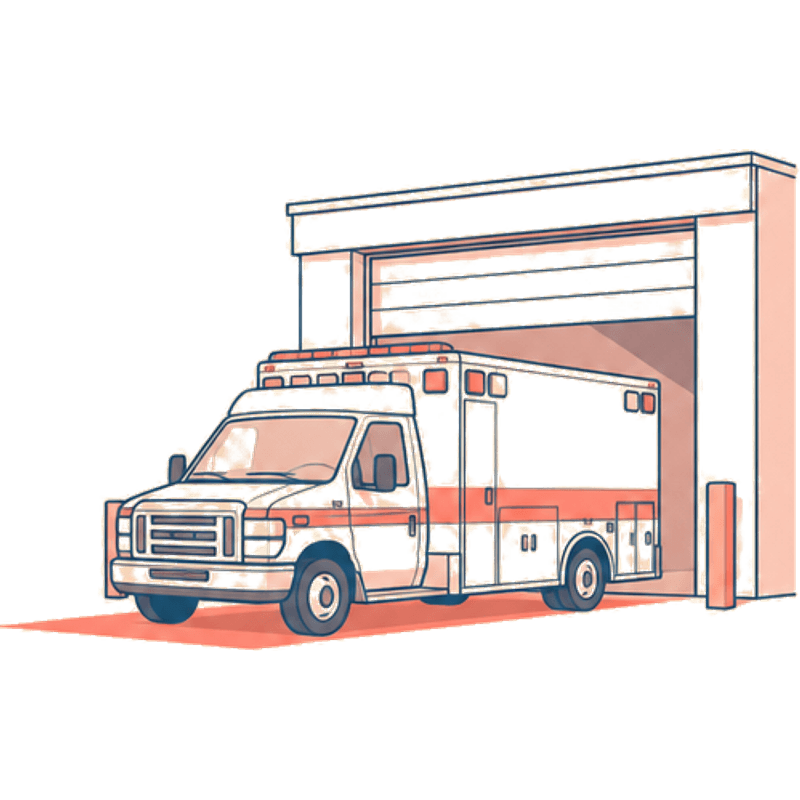
Emergency Services insurance. You make one call, We make the rest.
Rigs running lights all night, medics making calls in the back, and a county contract that wants a certificate before the first shift. We know this work, which insurers want it, and the certificate goes out the same day.
Tell us about your business.
What is Emergency Services insurance?
Coverage for a business that drives fast, treats patients on the move, and answers to the state. Commercial auto covers the ambulance or response vehicle in a collision, including the patient in the back. Professional liability covers the claim that a medic's care, or a delay in it, fell below the standard. General liability covers the person hurt at your station, and workers' compensation covers your crews, who are injured more often than most. State EMS regulators, hospital systems, and county contracts will usually ask for proof of all of it.
-
The rigs on the road
Commercial auto for ambulances, wheelchair vans, and supervisor vehicles, with liability for the other car and physical damage for yours.
-
A claim about patient care
Professional liability for alleged treatment errors, a missed assessment, or a delayed response, with legal defense included.
-
Your crews
Workers' compensation for medics, EMTs, and drivers, who lift, kneel, and ride in traffic every shift.
-
Your station and equipment
Property coverage for the building, and inland marine for the monitors, stretchers, and gear that ride on the rig.
Who needs Emergency Services insurance?
-
Private ambulance companies
Emergency and interfacility transport under county or hospital contracts.
-
Non-emergency medical transport
Wheelchair and stretcher vans running scheduled trips.
-
Event medical services
Standby medics and ambulances at races, concerts, and games.
-
Private fire and rescue companies
Industrial fire crews and contract rescue teams.
-
Air and critical care transport
Ground critical care units with nurse or paramedic staffing.
The level of care on the rig sets the policy.
An insurer asks whether you run basic or advanced life support, and whether your calls are emergency response or scheduled transport, because professional liability and auto coverage are both priced to that answer. Tell us what your medics are licensed to do and we place it with an insurer that writes your level of service.
Why businesses like yours choose Harper.
-
We know how EMS is underwritten
Response area, call volume, the mix of emergency and scheduled runs, and your medics' certification levels each move the quote. We gather them before the application goes out.
-
The insurers that write emergency services
Few standard companies do. We take your application to the specialty insurers that write ambulance and medical transport, compared side by side.
-
Certificates for contracts the same day
A county, a hospital, or an event organizer should never wait on paperwork. Send us the requirement as written and we match it, additional insureds and all.
-
Room to grow
Another rig, a new contract area, or a move from scheduled transport into emergency response extends your policy instead of restarting it.
Frequently asked questions
Does commercial auto cover the patient in the back?
Yes, when the policy is written for ambulance operations. We make sure the auto and the professional liability fit together so a collision with a patient on board has no gap between them.
Is professional liability separate from the auto policy?
Yes. Auto covers the crash, and professional liability covers the care. A claim about a medic's decision needs the second policy, whether the rig was moving or not.
The county wants a certificate with its own wording. Can you do that?
Yes. Municipal contracts usually come with exact additional insured and limit language, and the certificate goes out the same day matching it.
What does it cost?
Your number of rigs, your level of care, your drivers' records, and your call volume are what drive the price. We take one application to every insurer that covers emergency services, so the number you see already has competition in it.
Is workers' comp required for a volunteer or part-time crew?
In most states, yes, once anyone is paid, and some states require it for volunteers too. Tell us how your crews are staffed and we place it correctly.
Do we need separate coverage for standby at events?
Usually not, but tell us. Event standby is a different exposure from emergency response, and the insurer needs to know it is part of your work.